Why were you drawn to Eco paints?
"There is definitely another way and I began to research alternative options for my work as a painter decorator, options that would work to support the structure of an old building rather than against it."
A Victorian terraced house came onto the market with a cellar room so I began searching for information about damp proofing. This led me to various sites highlighting the problems with modern materials being applied to period properties. This was a real lightbulb moment and I realised that there was a far better way of decorating homes compared to everything I had just accepted during my past 40 years in the industry. I realised I’d been using products that trapped moisture under layers of plastic coatings, masking the underlying problem rather than solving it. From this moment onwards I began to learn more about the movement of moisture through a building and how we can use this to our advantage when caring properly for our homes and our living environments. I’ve since done a huge amount of reading about older systems such as lime, a porous substrate known for its ability to release water through capillarity. This allows moisture to flow through it and then be released back into the atmosphere instead of being stored behind layers of plastic paint that leads to rot and water ingress. This has led me to further research about the interior environments of our buildings and understand how this affects us as humans living and working within them. I soon learnt that the synthetic products were bad for our buildings and often are simply chosen due to cost, availability, familiarity and speed. There is definitely another way and I began to research alternative options for my work as a painter and decorator, options that would work to support the structure of an old building rather than against it. My journey into healthier paint and material choices and how best to repair and restore wooden windows and doors etc. began and has now really turned into a true passion of mine.

What do you wish more people thought about when redecorating?
For my clients to have an awareness that they are breathing in chemicals from the paint in their homes and gradually absorbing these toxic elements into their bodies. It’s realising the toxicity of the product that they’re choosing to put onto their walls, floors and ceilings in order to make their home more beautiful, when they are in fact breathing in lots of chemicals. When initially applied, paint gives off a lot of VOC’s which is what people are very familiar with. What people don’t realise is that the paint continues to give off VOC’s over its lifespan, especially during the first 6 months. A room painted with a healthier choice of paint does not have this. The initial smell is more earthy and far less noticeable to be around. Healthy interiors is an area that people are only just starting to really think about. The beauty and food world is very progressive and people clearly understand that what we apply to our skin and consume all has an effect on our hormones, mood and overall health. Therefore why not think about your home environment and truly make it the sanctuary you would want to live in.
"Healthy interiors is an area that people are only just starting to really think about... Why not think about your home environment and truly make it the sanctuary you would want to live in?"
What are your
thoughts on wallpaper nowadays?
"I’ve also been lucky enough to hang some really expensive wallpapers in my career. They certainly pose different challenges but the end results can be incredible. "
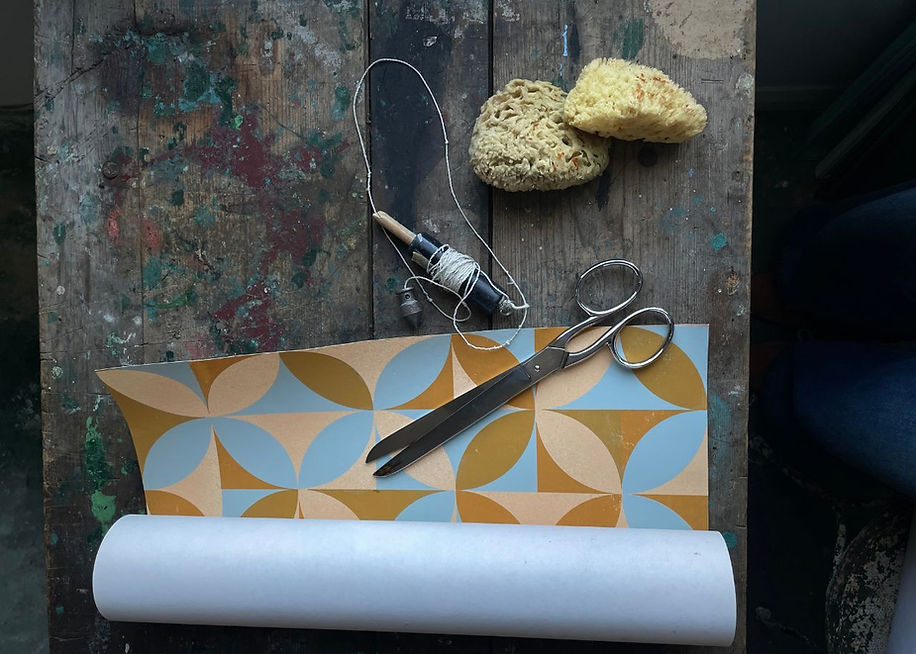
The world of wallpaper, again like paint, is so varied. In my 40 years of decorating I’ve hung some amazing wallpapers and coverings, from paper-backed silks and fabrics to hand-printed wallpapers, to the more modern digitally printed papers. It can be such a beautiful product, instantly creating impact within a space and a real favourite of mine. It’s so important to have patterns running continuously around a room despite the room’s internal and external corners and various architectural obstacles, and I’ve always taken great pride in pattern matching and hanging papers really well. It’s the care and attention to the small details that really makes a huge difference. Most people wouldn’t notice a tiny pattern match along a narrow element of wall near a door frame but, by going above and beyond, the final effect is really fabulous. So many modern wallpapers are now digitally printed now, and not always on good quality paper. This makes hanging them slightly more tricky as shrinkage can be a real issue and I never want to see a join. I’ve been known to get out my coloured pencils to carefully fill in if required. I’ve also been lucky enough to hang some really expensive wallpapers in my career. They certainly pose different challenges but the end results can be incredible. I’ve since studied on many different courses to expand my knowledge and understanding, and have learnt about lime plastering, lime mortars and natural insulation systems.


The World of Linseed Paints
"The process can be longer and more involved. I, however, strongly believe that the end results and the reduced level of long-term maintenance are well worth it."
An old system with a very relevant place in the modern world with positive results. Most modern paints create a plastic film that traps water next to the wood which can cause issues overtime such as wood rot and paint peeling off. Linseed paint offers a system that solves many of these issues due to its breathable qualities, allowing water to move through the paint. Linseed paint is perfect for use on outside woodwork but, as an older system, it does require the customer to be aware that the process can be longer and more involved. I however, strongly believe that the end results and the reduced level of long-term maintenance are well worth it. Linseed is available in many beautiful historic colours with several manufacturers here in the UK. The process of applying it is quite different compared to a modern paint system. It can’t be rushed and I leave it to dry for longer between coats as I find the end result so much better and longer lasting. It ideally needs to be applied to bare wood.
Research and continuing the education of this new passion
Heritage skills have been a real topic of conversation in our house since learning about healthier paint options. I studied City and Guilds in Decorating and Advanced Craft and next joined the National Joint Training Scheme for skilled Building Trades. I then worked for several different sized decorating businesses before finally setting up on my own. I find it very inspiring that I’ve run my own business for 30 years and now, in the past 5 years, I have discovered a whole new avenue of work within this field that I feel very passionate about. I’ve since studied on many different courses to expand my knowledge and understanding, and have learnt about lime plastering, lime mortars and natural insulation systems. Many of our recent family holidays have been based around courses with regular trips to the Scottish borders, Appleby and West Sussex to West Dean College. It’s been an amazing journey and I really relish learning these older skills and seeing how the systems work so well still today. As a highly experienced painter decorator, this new direction gives me a lot of pleasure as the results are so lovely.


